
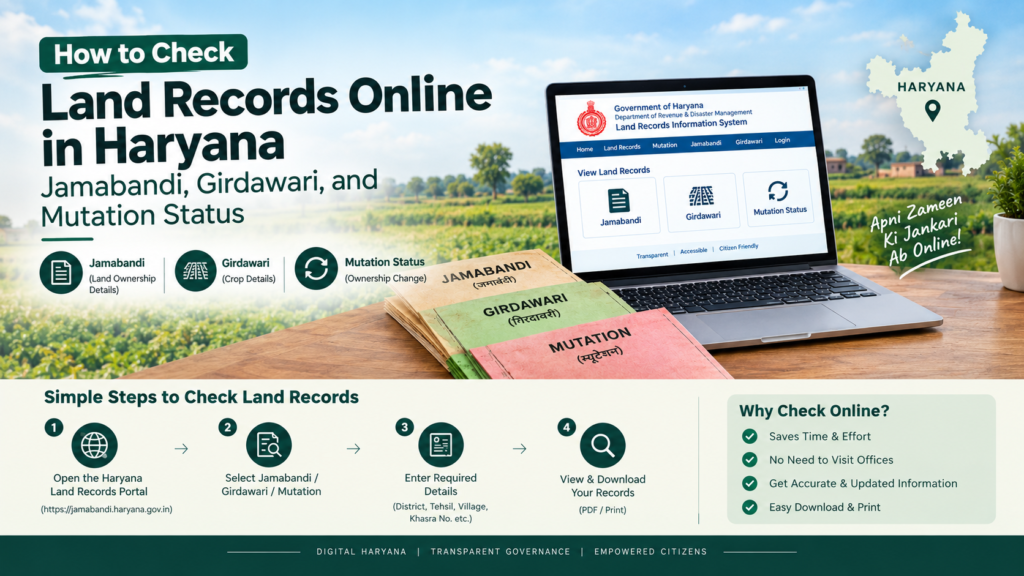
How to Check Land Records Online in Haryana: Jamabandi, Girdawari, and Mutation Status Before money changes hands in any land deal, one question matters more than the price: does the seller actually own the land? In Haryana, the answer sits in the state’s land records, and you can now check them online in a few minutes instead of visiting the patwari’s office. Buyers need this check as the first step of due diligence. Landowners need it too, to confirm their own entries are correct and up to date. This guide explains the three records people ask about most (Jamabandi, Girdawari, and mutation status) and how to check them. Understanding the Three Records Jamabandi Jamabandi is Haryana’s Record of Rights. It lists who owns a piece of land, the area, the khewat and khasra numbers, and related details. Banks also rely on it to confirm ownership during loan checks. A copy of it is called a Nakal. Girdawari Girdawari is a seasonal record kept by the patwari. It notes who is actually cultivating or holding the land and which crop is grown. It matters because the person in possession is sometimes different from the person named as owner. Mutation (Intkal) Mutation is the process of updating the revenue records after land changes hands through sale, inheritance, or gift. Registering a deed does not automatically update the Jamabandi. Mutation does. What to Keep Ready Before You Search You don’t need any documents to view a record, but the search is much faster if you have: District, tehsil, and village name Khewat or khasra number, or the owner’s name The approximate year of the record you want How to Check Jamabandi Online Haryana’s official land records portal is jamabandi.nic.in. The steps are: Open the portal and go to the Jamabandi section. Choose the option to view the Jamabandi Nakal for checking. Select the district, tehsil, and village. Pick your search method: khewat number, khasra number, or owner name. Select the Jamabandi year and open the record on screen. Searching by khasra number is usually the most reliable. Owner-name searches can return many similar names, so add the village and father’s name to narrow it down. If you are shortlisting residential plots in Sonipat, run this check on every plot you consider, and compare the record with what the seller or developer tells you before you pay a token amount. How to Check Mutation Status The portal also lets you check whether a mutation has been recorded. Look for the mutation (Intkal) status option, enter the district, tehsil, and village, and search using the mutation number or the land details. A mutation still pending after registry means the revenue record still shows the previous owner, which is a warning sign for any buyer. How to Read the Nakal A Nakal can look dense, but focus on these fields: Owner name and share: it should match the seller’s ID exactly. Khewat and khasra numbers: they should match the sale papers. Area: compare it with the area being sold. Land type: confirm it suits the intended use. Mortgage or charge entries: these show whether the land is already pledged. Red Flags to Watch For The seller’s name does not appear in the record. The area or number differs from the agreement. A mutation is pending from an earlier sale. The seller says they are acting through a Power of Attorney rather than owning the land. This is not the same as ownership, so read Power of Attorney vs. Sale Deed before going any further. Online View Copy vs. Certified Nakal The free copy you view online is suitable for checking and preliminary due diligence. A certified or verifiable Nakal, which usually requires login, OTP verification, and a nominal fee, is the copy to use when a bank, court, or government office asks for proof. Tips for Landowners Apply for mutation soon after registry, through the patwari or the portal. Check your Jamabandi periodically, since land records are updated in cycles and old entries can linger. Report spelling errors or wrong areas to the tehsil office early, because corrections get harder with time. Keep a downloaded copy of your latest record with your sale deed. Final Thoughts Checking Jamabandi, Girdawari, and mutation status takes only a few minutes and can prevent years of dispute. Buyers should match every detail in the record against the seller’s papers before paying. Landowners should treat the record as a living document and keep it current. Since portal menus and procedures can change, confirm the latest steps on the official site or with the local tehsil office.
Stamp Duty and Registration Charges in Haryana: A Complete Guide for Property Buyers The price on your agreement is rarely the final amount you pay for a property in Haryana. Stamp duty and registration charges are added at the time of registry. On a plot worth tens of lakhs, they can run into several lakhs. Knowing the numbers in advance helps you budget properly and avoids surprises at the sub-registrar’s office. What Is Stamp Duty, and Why Do You Pay It? Stamp duty is a tax the state government charges when property ownership changes hands. Paying it is what gives your sale deed legal standing as proof of transfer. Registration charges are a separate fee for recording that deed in official government records. Both are mandatory, and both are paid before or at the time of registry. Stamp Duty Rates in Haryana Rates for Men, Women, and Joint Buyers In most urban areas, stamp duty is commonly applied at 7% for male buyers and 5% for female buyers. For joint ownership, the rate is generally around 6%. Rates can differ depending on whether the property falls inside municipal limits, so check the exact rate for your location before you budget. The Women Buyer Concession Haryana gives women buyers a 2% concession on stamp duty. On a high-value plot, that is a significant saving. If you plan to register the property in a woman’s name, such as a wife, mother, or sister, confirm with the sub-registrar how the concession applies to your specific case, especially for joint ownership. Registration Charges in Haryana Registration charges are 1% of the property value, capped at ₹50,000. For properties above ₹50 lakh, the cap applies, so you won’t pay more than ₹50,000 however high the value goes. How Stamp Duty Is Calculated Collector Rate vs. Sale Price Stamp duty isn’t always charged on the price you negotiated. It is calculated on the higher of the actual sale price or the government’s collector rate (often called the circle rate) for that area. If you buy below the collector rate, you still pay duty on the collector rate. The Formula Total cost = (Property value × stamp duty %) + registration charges (1%, max ₹50,000) Worked Examples Here is how the numbers work at 7% for men and 5% for women, using a plot valued at ₹50 lakh and one valued at ₹80 lakh. ₹50 lakh plot, male buyer: stamp duty ₹3,50,000 + registration ₹50,000 = ₹4,00,000 ₹50 lakh plot, female buyer: stamp duty ₹2,50,000 + registration ₹50,000 = ₹3,00,000 (a saving of ₹1,00,000) ₹80 lakh plot, male buyer: stamp duty ₹5,60,000 + registration ₹50,000 (capped) = ₹6,10,000 Always calculate on the collector rate or the sale price, whichever is higher. This matters when you compare options. If you are looking at residential plots in Sonipat, for example, add these charges to the plot price before you decide your budget, because they can change which size fits comfortably. Other Costs to Budget For Stamp duty and registration are the biggest charges, but not the only ones. Plan for: Deed writer or lawyer fees E-stamp or documentation handling charges Mutation (updating the revenue records in your name) after registry Any pending dues on the property, such as maintenance or property tax How the Registration Process Works Step-by-Step Agree on the price and confirm the collector rate for the area. Get the sale deed drafted, with property details exactly matching the records. Pay the stamp duty and registration fee, usually through e-stamping. Visit the sub-registrar’s office on your appointment date with the buyer, seller, and two witnesses, all carrying valid ID. Complete the signatures and biometrics, and collect the registered deed. Registered Sale Deed, Not Just a Power of Attorney Some sellers offer a Power of Attorney arrangement to avoid the cost of a full transfer. This does not transfer ownership the way a registered sale deed does. Before you decide, read this guide on Power of Attorney vs. Sale Deed so you understand exactly what you would be buying. Legitimate Ways to Reduce the Burden Register in a woman’s name where it suits your family. The 2% concession can save lakhs. Check the collector rate before you negotiate. Agreeing a price far below it won’t reduce your duty. Avoid undervaluing the deed. It exposes both parties to penalties and legal trouble later. Claim the tax deduction. Under the old tax regime, stamp duty and registration charges on a new residential property can be eligible for a deduction under Section 80C, up to the overall limit, in the year of payment. Final Thoughts Stamp duty and registration charges are a fixed part of buying property in Haryana, so treat them as part of the price, not an afterthought. Work out the total cost using the collector rate, check whether the women buyer concession applies, and set aside a small buffer for deed and documentation fees. Because rates and rules can change, confirm the latest figures with the sub-registrar’s office or a lawyer before you pay.
Is a Plot a Better Investment Than an Apartment in Sonipat?
Is a Plot a Better Investment Than an Apartment in Sonipat? Ask ten property buyers in Sonipat whether land or a flat is the smarter buy, and you will likely hear ten different answers. Both can build wealth, but they work in very different ways. A plot is a blank canvas that grows in value with the area, while an apartment is a ready product that offers convenience from day one. This article compares the two on appreciation, maintenance, rental income, and liquidity, so you can decide based on your own goals. If you are currently exploring plots for sale in Sonipat, this comparison will help you weigh your options with a clear head. Appreciation: Which One Grows Faster? How Plots Gain Value A plot’s value is tied mainly to the land and its surroundings. As roads, schools, hospitals, and markets develop nearby, demand rises, and the land becomes more valuable. Because land does not age, the plot does not lose value through wear and tear. Over longer holding periods, this is the main reason many investors favour plots. How Apartments Gain Value An apartment’s price depends on both the land share and the building. While the location can push the price up, the structure itself ages over time, and older buildings often sell at a discount compared with newer ones. A well-maintained flat in a good society can still appreciate, but the gains are often steadier and less dramatic. To understand where prices currently stand, you can read about Sonipat Property Price Trends 2026 before setting a budget. Maintenance and Ongoing Costs The Plot Advantage A vacant plot asks very little of you. There are no monthly society charges, no lift or generator costs, and no sinking fund. Your main responsibilities are property tax where applicable, and keeping the boundary secure so the land is not encroached upon. That low carrying cost makes plots attractive for patient investors. The Apartment Reality Flats come with regular maintenance bills, and these can rise over time. Repairs, painting, and common-area upgrades are shared among owners, which adds to your yearly expense. In return, you get security, parking, lifts, and amenities, which many families value highly. Rental Income: Where Apartments Lead Steady Monthly Returns If regular income matters to you, apartments usually have the edge. A ready flat can be rented out quickly, particularly near workplaces, colleges, or industrial areas, and the rent starts flowing immediately. Limited Income from Vacant Plots A vacant plot generally earns nothing until you build on it or lease it for another use. That means your return depends almost entirely on appreciation. Some owners construct rental floors later, but that requires extra investment, approvals, and time. So for buyers who want income right away, an apartment may suit better. Liquidity: How Easily Can You Sell? Selling a Plot Plots can take longer to sell, especially in newer or less developed areas. Selling usually depends on finding the right buyer who shares your vision for the land. In popular, well-connected colonies, however, demand can be healthy, and a well-priced plot with clear papers tends to attract interest. Selling an Apartment Flats in established societies often find buyers faster because they are ready to move into. Even so, resale value depends on the building’s age, condition, and the project’s reputation. Neither option is truly instant, so avoid putting money here that you may need on short notice. Flexibility and Control Build Your Own Way A plot lets you design the house you actually want. You decide the layout, the number of floors, and the finishing. You can build in phases as your budget and family grow, which is hard to replicate with a fixed apartment layout. Convenience of a Ready Home On the other hand, an apartment removes the stress of design, approvals, and construction. If you want to move in soon and avoid managing contractors, a flat saves time and effort. So, Which One Should You Choose? Choose a Plot If You have a long investment horizon, want low holding costs, and value freedom in design. You should also be comfortable with slower resale and with managing legal checks and construction later. Choose an Apartment If You want rental income, quick possession, and built-in security and amenities. It also suits buyers who prefer minimal responsibility after purchase. Final Thoughts There is no universal winner. Plots tend to reward patience, offering strong long-term appreciation and low upkeep, while apartments offer convenience, rental income, and easier day-to-day living. The best choice comes down to your budget, timeline, and purpose. Whichever you pick, verify the title and approvals, visit the site, compare similar listings, and seek legal advice before paying. A well-researched decision will serve you far better than a rushed one.
Plot Size Guide: 100, 150, 200, and 250 Square Yards and What You Can Build
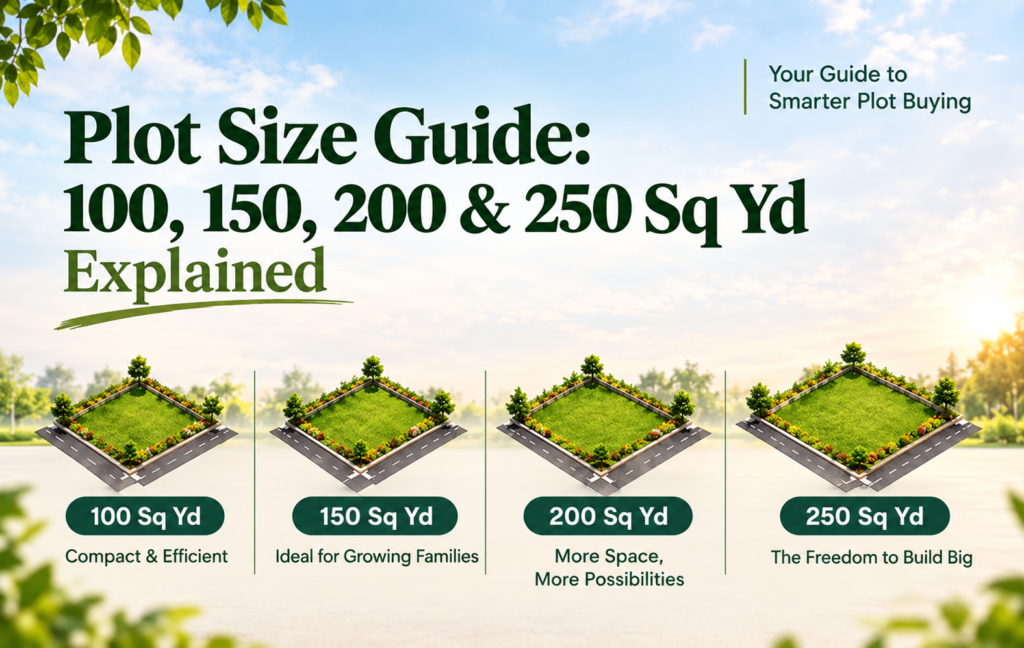
Plot Size Guide: 100, 150, 200, and 250 Square Yards and What You Can Build Choosing the right plot size is one of the first decisions every buyer faces, and it quietly shapes everything that follows: your design options, your construction budget, and even how easily you can resell. Many first-time buyers focus only on price per square yard and forget to ask what the land can actually hold. This guide breaks down the most common plot sizes and what each one can realistically support. If you are comparing plots for sale in Sonipat, it will help you match size to need. First, Understand the Basics Converting Square Yards to Square Feet One square yard equals nine square feet. That makes a 100 sq. yd. plot about 900 sq. ft., a 150 sq. yd. plot about 1,350 sq. ft., a 200 sq. yd. plot about 1,800 sq. ft., and a 250 sq. yd. plot about 2,250 sq. ft. Keep these numbers in mind, because builders and brokers often switch between units. Plot Area Is Not Built-Up Area You cannot cover every inch of your plot. Local rules and colony norms set limits on ground coverage, floor area, height, and the open space you must leave around the building. These limits vary by colony and authority, so always check the applicable norms before finalising a design. As a rough idea, the usable footprint is noticeably smaller than the plot itself. What You Can Build on Each Plot Size 100 Sq. Yd. Plot This is the entry-level choice, well suited to compact family homes and first-time buyers working within a tight budget. A smart layout can fit two or three bedrooms across two or three floors, along with a small parking space or a stilt area. Space is limited, so design matters. Think vertical living, efficient staircases, and good natural light. Best for: Small families, budget-conscious buyers, and rental-focused construction. 150 Sq. Yd. Plot A 150 sq. yd. plot gives you more breathing room without a large jump in cost. You can plan a comfortable three-bedroom home with a proper drawing room, a modest courtyard or lawn strip, and parking for one or two vehicles. It is a popular middle option for families who want comfort but not excess. Best for: Nuclear families and buyers who want a balance of space and affordability. 200 Sq. Yd. Plot This size opens up many more possibilities. You can plan a spacious independent house with larger bedrooms, a dedicated dining area, a small garden, and parking for two cars. Some owners also build a separate floor for rental or for extended family, subject to local rules. Best for: Larger families, joint households, and owners who want future flexibility. 250 Sq. Yd. Plot The biggest of the four offers real design freedom. It can support a generously sized home with wide rooms, a front lawn, a private seating area, and ample parking. Buyers often use this size to create a premium, villa-style residence with a distinct identity. Best for: Buyers who prioritise space, privacy, and a long-term family home. How Plot Size Affects Your Budget Land Cost and Construction Cost A bigger plot costs more to buy, and it usually costs more to build on too. More land means more boundary work, more finishing, and often a higher overall construction bill. A smaller plot saves money upfront but may require smarter and sometimes costlier design choices, such as building upward to gain space. Extra Charges to Plan For Remember that the purchase price is only part of the spending. Registration, stamp duty, development charges, and approval fees all add up. If you plan to finance the purchase, check your eligibility early, since lenders treat plots differently from ready homes. You can read more about plots loan criteria in Haryana to understand what documents and conditions apply. How to Pick the Right Size for You Think About Your Family Today and Tomorrow Count how many people will live in the house now, and how that may change over the next ten to fifteen years. A plot that feels perfect today can feel cramped later if your family grows. Consider Resale and Rental Potential Mid-sized plots such as 150 and 200 sq. yd. are often easier to resell because they appeal to a wide range of buyers. Very large plots can attract fewer buyers, while very small ones may limit design options. If you plan to rent out part of the building, choose a size that supports a practical layout. Check the Plot’s Shape and Facing Two plots of equal size can behave very differently. A regular, rectangular plot with a good frontage is easier to design than a narrow or irregular one. Road width, corner position, and the direction the plot faces also affect light, ventilation, and value. Final Thoughts There is no single best plot size, only the one that fits your family, your budget, and your plans. A 100 sq. yd. plot rewards smart, compact design, 150 and 200 sq. yd. plots offer a comfortable balance, and 250 sq. yd. gives you room to build something special. Before you decide, visit the site, review the layout plan, confirm the construction norms, and run the numbers on total cost. A well-chosen plot size makes building easier and keeps your investment stronger for years.

Power of Attorney vs. Sale Deed: What’s the Legal Difference? A Power of Attorney (POA) authorizes someone to act on a property owner’s behalf, it does not transfer ownership. Only a registered sale deed legally transfers title from seller to buyer. A “GPA sale” is a common but legally weak arrangement, and buyers who rely on it instead of a proper sale deed don’t actually become the legal owner of the property. Why This Confusion Persists GPA-based property transactions have circulated in the Indian real estate market for decades, especially in areas where full documentation felt slow or expensive. The practice became common enough that many buyers still assume it’s a valid, complete way to purchase land. It isn’t, and understanding why matters considerably before you consider plots for sale in Sonipat or any other property, buying, or documenting a purchase you already made. Where the Practice Originated GPA-based sales became popular largely as a way to avoid stamp duty and registration costs, or to speed up transactions in cases where full title clearance was complicated. Over time, this created a widespread but legally fragile pattern that courts have since pushed back against directly. What a Power of Attorney Actually Does A POA is a legal authorization, not a transfer of ownership, and understanding that distinction is the core of this entire topic. It Grants Authority, Not Title A Power of Attorney allows one person, the agent, to act on behalf of another, the principal, for specified purposes: signing documents, managing property, or handling transactions. It’s a tool for delegation, commonly used when someone can’t be physically present, an NRI managing property remotely, for example, not a mechanism for transferring legal ownership of real estate. General Power of Attorney vs. Specific Power of Attorney A General Power of Attorney (GPA) grants broad authority across many matters, while a Specific Power of Attorney is limited to a defined task, such as representing someone during a single registration appointment. Neither type, regardless of how broad its wording, legally conveys ownership of immovable property on its own. Why a “GPA Sale” Isn’t a Real Sale This is the specific arrangement that causes the most confusion, and the one buyers need to understand clearly before considering it. What a GPA Sale Typically Involves In a GPA-based transaction, the seller executes a Power of Attorney in favor of the buyer, sometimes alongside a will or an agreement to sell, instead of a registered sale deed. The buyer takes possession and often treats the property as their own, but legally, title never actually transfers. Why Courts Have Rejected This as a Valid Transfer India’s Supreme Court has clarified that GPA-based transactions do not constitute valid transfer of immovable property title. A GPA holder can act on the seller’s behalf, but the underlying ownership legally remains with the original seller, or their legal heirs, unless a proper registered sale deed is executed. Why Only a Registered Sale Deed Transfers Ownership This is the document that actually does what many buyers mistakenly assume a GPA accomplishes. The Sale Deed Is the Legal Instrument of Transfer A sale deed, once signed by both parties and registered with the local sub-registrar’s office, is the document that legally transfers ownership from seller to buyer. Registration isn’t optional paperwork, it’s what gives the transaction legal standing and public record. What Happens Without It Without a registered sale deed, a buyer holding only a GPA has no enforceable ownership claim. If the original seller, or their heirs, later disputes the arrangement, sells the property to someone else, or passes away, the GPA holder’s position becomes legally precarious, sometimes with no recourse at all. Real Risks Buyers Face With GPA-Based Purchases Beyond the legal technicality, this arrangement creates practical, financial risk that plays out in real situations. Difficulty Securing Loans or Reselling Banks generally won’t finance a property held only under a GPA, since there’s no registered title to secure the loan against. Reselling a GPA-held property is similarly difficult, since a prospective buyer’s own lawyer will flag the same ownership gap during due diligence. Vulnerability If the Original Owner Passes Away A Power of Attorney becomes void upon the death of the person who granted it. If the original seller dies before a proper sale deed is executed, the GPA holder’s authority disappears entirely, potentially leaving the buyer with no legal claim to a property they’ve lived in and paid for. What Buyers Should Insist On Given these risks, the right approach is straightforward, even if a seller presents a GPA arrangement as simpler or faster. Always Require a Registered Sale Deed Regardless of how a seller frames the transaction, insist on a full, registered sale deed as the basis of the purchase. If a POA is involved, for instance, because the seller is represented by an authorized agent, that’s acceptable, but it should support a proper sale deed execution, not replace it. Verify Plots Within Planned Developments Directly Buyers considering a larger plot with future plans, such as understanding plot subdivision rules in Haryana, should apply this same documentation discipline throughout, since a subdivided plot inherits any title weakness present in the original, undivided parcel. Frequently Asked Questions Can a GPA holder legally sell property on someone else’s behalf? Yes, a GPA holder can execute a sale deed on the principal’s behalf if the POA specifically authorizes this. The resulting sale deed, once registered, is what transfers ownership, the POA itself is not the transfer. Is a GPA sale ever legally valid in India? No, the Supreme Court has clarified that GPA-based arrangements do not constitute a valid transfer of immovable property title under Indian law, regardless of how long the buyer has held possession. What should I do if I already hold property under a GPA arrangement? Consult a property lawyer promptly to formalize a proper, registered sale deed with the original owner or their legal heirs, before any complication, such as the owner’s death or a competing claim, makes

Plot Subdivision Rules in Haryana: Can You Split a Plot After Buying? Buying a larger plot with the idea that you can split it later, one portion for your own home, another to sell or pass on to family, sounds like a reasonable, flexible plan. Whether that plan is actually legal depends entirely on Haryana’s specific subdivision rules, and this isn’t a detail most buyers think to check before purchase. If you’re weighing a larger option among plots in Sonipat with future flexibility in mind, understanding these rules now saves you from discovering the restrictions only after you already own the land. Why Subdivision Isn’t Simply “Your Land, Your Choice” It’s a natural assumption, once you own a plot outright, shouldn’t you be free to divide it however you like? In Haryana, that assumption doesn’t hold, subdivision is regulated activity, not a private decision left entirely to the owner. Why the State Regulates This at All Unregulated subdivision can undermine an area’s planned infrastructure, roads, drainage, and utility lines are all designed around a specific layout, and uncontrolled splitting of plots can strain that infrastructure or create access and parking problems for the resulting smaller parcels. This is why Haryana’s Urban Local Bodies department maintains a formal policy governing when and how subdivision is permitted. What the Current Haryana Policy Actually Says Haryana has a specific, published framework covering subdivision within planned municipal schemes, and it’s worth understanding its core terms directly. Minimum Plot Size Requirements Under the state’s policy, the minimum original plot size eligible for subdivision is 200 square meters. This means a smaller plot, even one you own outright, generally doesn’t qualify for splitting under this framework, regardless of your personal intentions for the land. Minimum Size for Each Resulting Sub-Plot Beyond the original plot’s minimum size, each newly created sub-plot resulting from the division must itself be no smaller than 100 square meters. In practice, this means a 200-square-meter plot can typically only be split into two portions, not further subdivided into smaller fragments. Which Plots the Policy Actually Covers This particular framework applies specifically to plots within planned schemes, including Town Planning Schemes, Improvement Trust Schemes, and Rehabilitation Schemes, developed prior to 1980, situated within municipal areas. Plots outside these specific scheme categories, including many modern, privately developed gated societies, fall under different approval processes entirely. The Approval Process: What’s Actually Required Even when a plot meets the minimum size threshold, subdivision isn’t automatic, it requires formal application and approval. Applying Through the Correct Form The process generally involves submitting a formal application, using distinct forms depending on whether you’re regularizing an already-informally-divided plot or seeking permission for a fresh, new subdivision. This distinction matters, since applying under the wrong category can delay or complicate approval. Road Access and Parking Requirements Approved subdivisions must ensure each resulting sub-plot has proper access from the road shown in the original layout plan, and must include adequate parking provisions in line with Haryana’s building code guidelines. A subdivision plan that creates a sub-plot without clear, compliant road access is unlikely to receive approval. Ground Coverage and FAR: What Changes After Subdivision Once a plot is legally subdivided, construction rights on each resulting portion are governed by Haryana’s building code, and these figures vary meaningfully depending on the final plot size. How Smaller Plots Are Treated Differently Under the amended Haryana Building Code, plots up to 250 square meters are permitted ground coverage of up to 75 percent, with a floor area ratio of up to 145 to 165 percent depending on the exact size bracket. This means a subdivided, smaller plot often comes with different, sometimes more generous, construction allowances than what applied to the original, larger parcel. Why This Matters for Planning Ahead If you’re specifically buying a larger plot with subdivision in mind, it’s worth understanding that construction rules will apply separately to each resulting sub-plot once divided, not simply as a proportional share of the original plot’s allowances. This affects how you should plan any future construction across the divided portions. Why This Matters for Buyers Considering a Larger Plot Understanding these rules changes how a buyer should evaluate a larger plot purchase from the outset, not as an afterthought once ownership is already settled. Buying With Flexibility in Mind If future subdivision, whether to sell a portion, gift it to family, or build separately for different generations, is part of your long-term plan, confirming the plot meets the 200-square-meter minimum and sits within an eligible scheme category should happen before you buy, not after. The Risk of Assuming Subdivision Is Automatic Buyers sometimes purchase a large plot assuming they can simply divide it whenever convenient, only to discover the plot doesn’t qualify under current policy, or that the approval process takes considerably longer than expected. This assumption can meaningfully affect the practical value of buying larger versus buying two separate, appropriately sized plots from the start. A Simpler Alternative: Financing the Right Size From the Start For buyers who don’t specifically need future subdivision flexibility, it’s often more straightforward to purchase the plot size that actually matches current needs, rather than buying larger with subdivision as a backup plan. Buyers financing this decision can also explore plot loans in Haryana to understand how loan eligibility and terms vary by plot size, since financing considerations sometimes make a right-sized purchase more practical than betting on future subdivision approval. Final Thoughts Subdivision rules in Haryana are specific and not automatically available to every plot owner, size thresholds, scheme eligibility, and formal approval all factor in before a plot can legally be split. Buyers considering a larger plot specifically for future flexibility should verify these details directly against the current policy before purchase, rather than assuming subdivision will simply be possible whenever they decide they want it.
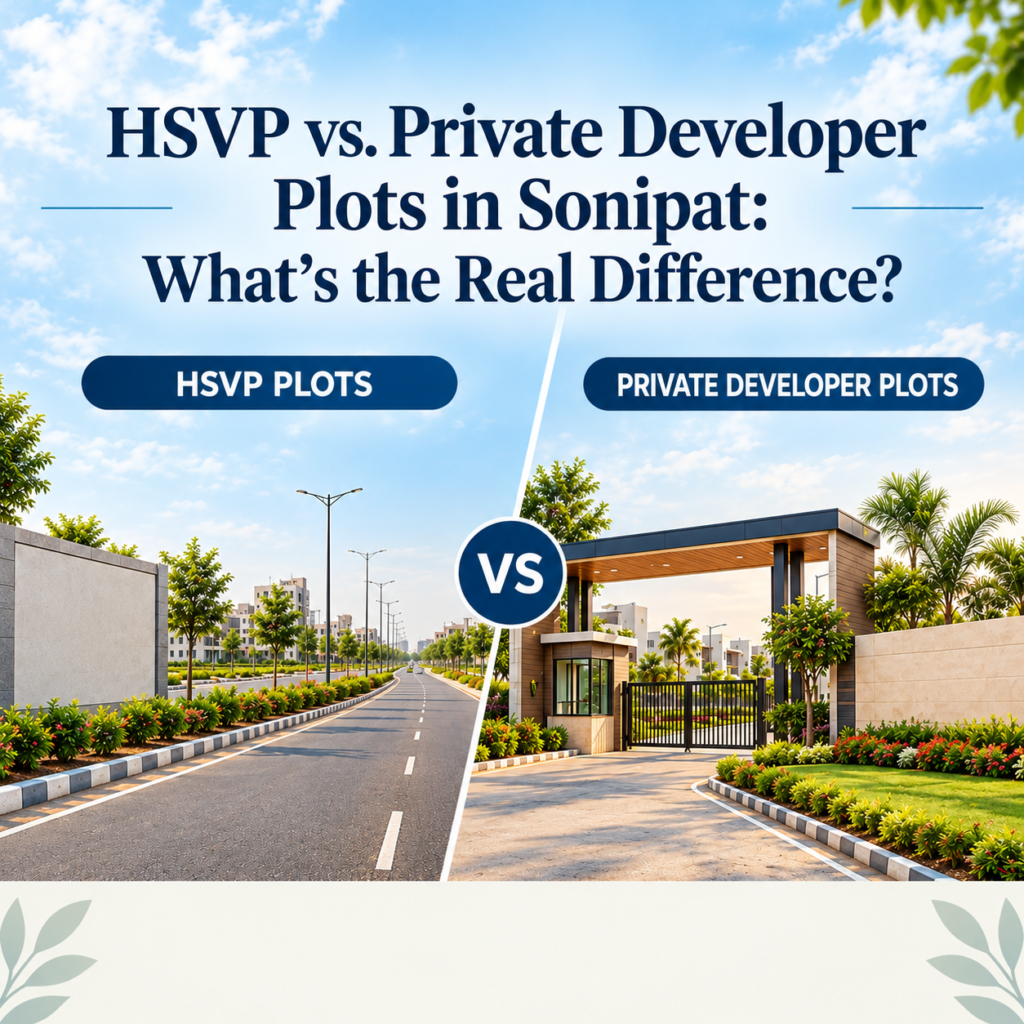
HSVP vs. Private Developer Plots in Sonipat: What’s the Real Difference? Ask around about buying land in Sonipat, and you’ll quickly run into two very different categories that often get discussed as if they’re interchangeable: HSVP plots and private developer plots. They aren’t. Each comes with its own allotment process, legal framework, and long-term ownership experience, and understanding the difference properly changes how you should approach the entire buying decision. If you’re comparing plots in Sonipat across both categories, this distinction is worth getting right before you commit to either. What HSVP Plots Actually Are Before comparing the two, it helps to understand exactly what HSVP represents and how it differs structurally from a private project. A Government Body, Not a Developer HSVP, the Haryana Shehri Vikas Pradhikaran (formerly HUDA), is a state government body responsible for planned urban development across Haryana, including the allotment of residential plots directly to the public. Unlike a private developer, HSVP isn’t running a business selling land for profit in the conventional sense, it’s executing state-planned urban expansion. How HSVP Plots Are Typically Allotted HSVP plots are generally allotted through a structured process, sometimes via draw of lots for specific schemes, sometimes through auction for higher-value or commercial plots. This process is government-administered, with defined eligibility criteria, application windows, and allotment procedures that differ meaningfully from simply walking into a sales office and booking a plot. What Private Developer Plots Actually Are Private developer plots operate under a completely different structure, even when they’re part of a government-linked scheme like DDJAY. Developer-Led, Market-Driven Sales Private developer plots are sold directly by a real estate company, which has typically obtained a license to develop residential colonies under Haryana’s regulatory framework, sometimes independently, sometimes under a scheme like DDJAY that still involves private developers executing government-approved layouts. A More Direct, Immediate Buying Process Unlike HSVP’s application-and-draw system, private developer plots are generally available for purchase directly, first-come, first-served, or through direct booking, without the same waiting period or allotment uncertainty that government schemes often involve. Comparing the Allotment Process This is often the first practical difference buyers encounter, and it shapes the entire experience from the very start. HSVP’s Structured, Sometimes Unpredictable Process Applying for an HSVP plot typically means entering a formal application process, sometimes competitive, with allotment decided by draw or auction rather than guaranteed purchase. This can mean waiting through an application cycle without certainty of actually securing a specific plot, or any plot at all in a given round. Private Developers’ More Direct Access Private developer plots typically offer more control and certainty for the buyer, you can select a specific plot, size, and location within the project directly, without the uncertainty of a lottery-style allotment process. For buyers who know exactly what they want and prefer certainty over waiting, this is a significant practical advantage. Legal Standing and Documentation Both categories carry legitimate legal standing, but the nature of that standing differs in ways worth understanding. HSVP’s Government-Backed Title HSVP plots carry the assurance of direct government allotment, which generally means a very clear, well-documented ownership history from the point of allotment onward, since the land itself was under government control before being allotted. Private Developer Documentation Private developer plots require verifying the developer’s DTCP license, RERA registration, and the underlying land title the developer acquired before launching the project. This isn’t inherently less secure, but it does shift more of the verification responsibility onto the buyer, checking that the developer’s own paperwork is genuinely in order. Resale Flexibility: Where the Real Differences Show Up This is one of the more practically significant differences between the two options, and it often surprises first-time buyers. Restrictions on HSVP Plots HSVP plots frequently come with resale restrictions, particularly in the years immediately following allotment, since many schemes are designed to prevent speculative flipping and ensure genuine residential use. Buyers need to understand these lock-in periods and conditions before assuming they can resell freely whenever they choose. Fewer Restrictions on Private Developer Plots Private developer plots generally offer more straightforward resale flexibility once the sale deed is registered, without the same government-imposed holding periods, making them more attractive to buyers who want the option to exit or upgrade their investment on their own timeline. Infrastructure and Amenities: A Meaningful Practical Difference Beyond legal structure, the actual living experience differs considerably between the two categories. HSVP Sectors: Established but Basic HSVP-developed sectors typically offer solid, government-maintained basic infrastructure, roads, drainage, and utilities, but generally without the additional gated security, curated amenities, or coordinated aesthetic planning that a private, purpose-built society offers. Private Gated Societies: Coordinated, Amenity-Rich Development Private developer projects, particularly gated societies, are typically designed with a unified vision, coordinated security, parks, playgrounds, and amenities built specifically to enhance the living experience, since attracting and retaining buyers depends directly on the quality of that experience. Which One Should You Choose? The right choice depends on what you’re prioritizing, certainty and control, or the specific assurance of direct government allotment. Choose HSVP If You’re comfortable with a potentially competitive, structured application process, want the specific assurance of direct government-administered allotment, and don’t mind resale restrictions during an initial holding period. Choose a Private Developer Plot If You want direct control over plot selection, faster access without a lottery-style process, more resale flexibility, and the amenities and infrastructure coordination that come with a purpose-built, gated development. A Broader Consideration for Investors For buyers weighing this decision as part of a larger regional strategy, it’s worth stepping back and evaluating Sonipat within the context of the best place to invest in Delhi NCR overall, since the HSVP-versus-private decision is only one layer of a broader location and asset-type choice that shapes long-term returns. Final Thoughts HSVP and private developer plots aren’t simply two flavors of the same purchase, they represent genuinely different allotment systems, legal frameworks, and ownership experiences. Understanding these differences clearly, rather than assuming one is universally better, helps buyers choose the option that
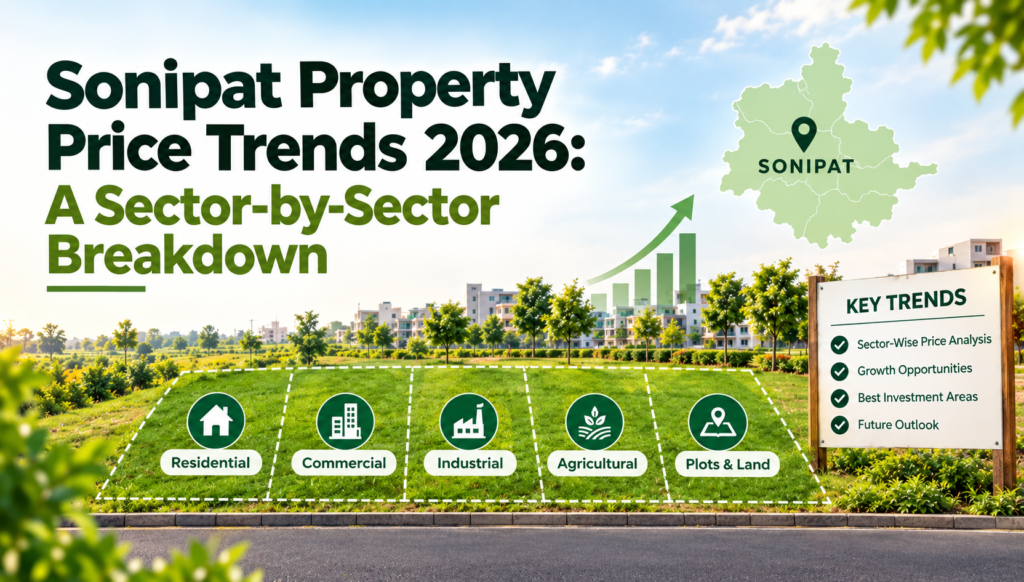
Sonipat Property Price Trends 2026: A Sector-by-Sector Breakdown Ask five different people what a plot in Sonipat costs, and you’ll likely get five different answers, and all of them could be correct. Sonipat isn’t one uniform market, it’s a collection of micro-markets, each moving at its own pace depending on infrastructure, industrial activity, and how developed the surrounding area already is. Understanding these differences properly, rather than relying on a single citywide average, is what actually helps buyers evaluate plots for sale in Sonipat with confidence. Why a Single Citywide Average Doesn’t Tell the Full Story Sonipat’s average property rate currently sits around ₹7,559 per square foot citywide, but that number hides enormous variation between locations. The Problem With Averaging Very Different Markets Together A citywide average blends a premium, well-developed sector with a still-emerging industrial belt into one misleading figure. Buyers who anchor their expectations to this average alone often end up either overpaying in an affordable pocket or underestimating what a premium sector genuinely costs. Kundli: The Established, Border-Adjacent Market Kundli remains one of the most talked-about pockets in Sonipat, and its pricing reflects that maturity. Current Pricing and Recent Growth Kundli’s average rates sit around ₹4,600 per square foot, positioning it as one of the more accessible entry points into Sonipat’s market. What stands out more than the current price, though, is the growth trajectory, Kundli has recorded roughly 73.6 percent price appreciation over the past three years, among the strongest in the entire district. Why Kundli Continues to Perform Its proximity to the Delhi border, combined with the Kundli Industrial Area and direct KMP Expressway access, gives it a tenant and buyer base that isn’t purely speculative. This is a market driven by genuine demand, not just anticipation. Rai: Riding the Industrial Wave Rai doesn’t get discussed as often as Kundli or Kharkhoda, but its growth is closely tied to a similar industrial story. What’s Driving Demand Here The Rai Industrial Estate has steadily expanded, generating employment that translates directly into local housing demand. Buyers here tend to be a mix of workforce-linked end users and investors betting on continued industrial growth along this stretch. How It Compares to Neighboring Pockets Rai generally remains more affordable than Kundli, making it attractive for buyers priced out of Kundli’s more established rates while still wanting exposure to the same industrial growth corridor. Kharkhoda: The Maruti Suzuki Effect Few areas in Sonipat have a clearer, more specific growth catalyst than Kharkhoda right now. Current Price Range Land rates in Kharkhoda currently range from roughly ₹4,500 to ₹7,100 per square foot, having risen close to 5 percent in the past year alone and nearly 27 percent over the past decade. That’s a meaningful acceleration, and it’s not happening in isolation. The Maruti Suzuki Plant’s Impact Kharkhoda is home to the newly inaugurated Maruti Suzuki manufacturing plant, a project expected to generate over 21,000 jobs at full capacity. Industrial investment on this scale historically translates into sustained housing demand, both from the workforce itself and from investors positioning ahead of that demand materializing fully. Sector 71: Where Newer, Planned Development Sits Sector 71 represents a different category altogether, planned, gated development rather than an organically growing industrial belt. What Sets This Category Apart Plots within properly planned, RERA-registered societies in sectors like this tend to price differently from open-market land in Kundli or Kharkhoda, since buyers are paying for coordinated infrastructure, roads, security, and documentation clarity, alongside the land itself. Why This Matters for Long-Term Value A planned sector’s appreciation is tied not just to the broader Sonipat growth story, but to the specific project’s own development timeline, as infrastructure within the society itself moves from planned to completed. Sector 35 and Sector 63: The Highest Appreciation in the City These two sectors deserve specific attention, since they’ve posted some of the strongest returns anywhere in Sonipat recently. The Numbers Behind the Growth Sector 63 has seen roughly 79.3 percent price appreciation over the past three years, with Sector 35 close behind at approximately 77.8 percent, both outpacing Kundli’s already strong growth. These aren’t marginal gains, they represent some of the fastest-appreciating pockets in the entire district. What’s Fueling This Specific Growth Both sectors benefit from proximity to established infrastructure and, in Sector 35’s case, closeness to institutions like O.P. Jindal Global University, which helps sustain consistent housing demand beyond pure speculation. Ganaur: The Budget End of the Market For buyers prioritizing affordability above all else, Ganaur represents the more accessible end of Sonipat’s pricing spectrum. Why It Remains the Lowest-Priced Option Ganaur’s average rates sit around ₹4,150 per square foot, the most affordable figure among Sonipat’s commonly discussed localities. This makes it a genuine option for buyers with tighter budgets, though it typically comes with a longer runway before infrastructure and connectivity catch up to more established sectors. What This Sector-by-Sector Picture Means for Buyers Pulling these numbers together, a clear pattern emerges: growth isn’t evenly distributed, it’s concentrated in areas with specific catalysts, industrial investment, institutional presence, or planned infrastructure. Matching Location to Your Priorities Buyers prioritizing near-term appreciation might lean toward Sector 35, Sector 63, or Kharkhoda given their current growth trajectory. Buyers prioritizing affordability and a longer investment horizon might find Ganaur or Rai more suitable starting points. Final Thoughts Sonipat’s property market rewards buyers who look past the citywide average and understand what’s actually happening sector by sector. Kundli’s maturity, Kharkhoda’s industrial momentum, and Sector 35 and 63’s standout appreciation all tell different parts of the same broader growth story, and knowing which part matches your own goals is what turns a general interest in Sonipat into a genuinely informed decision.
CLU Certificate Explained: Why Some “Residential” Land in Sonipat Isn’t Actually Residential One of the most overlooked risks in buying land in Haryana isn’t about title disputes or fraudulent sellers, it’s about zoning. A plot can be marketed, priced, and sold as “residential” while technically sitting on land that’s officially classified for industrial or agricultural use. The document that bridges this gap, or reveals when it hasn’t been bridged at all, is called a CLU certificate, and most buyers have never heard of it until it’s too late. If you’re comparing plots for sale in Sonipat, understanding CLU status is one of the most important, and most skipped, verification steps in the entire process. What CLU Actually Stands For Before getting into why this matters, it’s worth understanding exactly what this certificate is and what it does. Change of Land Use, Explained Simply CLU stands for Change of Land Use, a formal government approval that permits land originally zoned for one purpose, typically agricultural or industrial, to be legally developed for a different purpose, in this case, residential use. Without this approval, land retains its original zoning classification regardless of how it’s being marketed or sold. Why This Matters So Much in Sonipat Specifically This isn’t a generic, theoretical risk, it’s a documented, specific issue tied directly to how Sonipat’s district development plan is structured. Industrial-Zoned Belts Along the KMP Corridor A meaningful share of land along the KMP Expressway corridor, particularly in and around Rai, Barhi, and Kharkhoda, is officially designated as industrial rather than residential under Sonipat’s development plan. This is precisely the belt seeing significant plotted development activity right now, driven by growing industrial investment and improving connectivity, which makes zoning verification especially important in these specific areas. Why Sellers Don’t Always Disclose This In some cases, land is marketed as residential in good faith by sellers who assume conversion is a formality, or simply haven’t checked the zoning status themselves. In other cases, it’s a more deliberate omission, since disclosing pending or unresolved industrial zoning would likely reduce buyer interest. Either way, the responsibility for catching this falls on the buyer, not the seller. What Happens If You Buy Without CLU Clearance Understanding the actual consequences makes clear why this isn’t a minor technicality. Legal Risk to Your Construction Plans If you build on land that hasn’t received proper CLU approval for residential use, that construction can technically be considered unauthorized, regardless of how legitimate the sale deed itself appears. This creates real exposure to future disputes, demolition orders, or complications when trying to sell the property later. Impact on Resale and Financing Banks are generally reluctant to finance construction or extend home loans against land without confirmed CLU status for residential use, since the loan itself carries legal risk tied to the land’s actual zoning. This can leave buyers unable to secure financing even after purchase, a complication that only surfaces well after the money has already changed hands. How to Check Whether a Plot Has CLU Clearance Fortunately, this is a verifiable detail, not something buyers have to take on faith. Request the CLU Certificate Directly Before finalizing any purchase, ask the seller or developer directly for the CLU certificate covering the specific plot, not just a general assurance that “the area is residential.” A legitimate certificate will reference the specific land parcel and confirm approval for residential development. Cross-Check Zoning Against the District Development Plan Beyond the certificate itself, it’s worth independently checking the plot’s zoning classification against Sonipat’s official district development plan, available through the Department of Town and Country Planning, Haryana. This cross-check confirms the CLU certificate, if provided, actually aligns with the land’s broader zoning designation. When CLU Verification Matters Less Not every plot purchase carries this same level of zoning risk, and it’s worth understanding when this concern is more or less relevant. Established, Long-Developed Sectors Plots within long-established HSVP sectors or well-known, mature residential belts typically carry far less zoning ambiguity, since these areas have operated as clearly residential zones for years, with CLU status effectively settled long before you’re evaluating a purchase there. Properly Licensed, RERA-Registered Developments Plots within a project that’s already DTCP-licensed and RERA-registered as a residential development have generally already secured the necessary zoning approvals as part of that registration process, since a legitimate residential license wouldn’t be issued without confirmed CLU status where applicable. Why This Deserves the Same Attention as Title Verification Buyers are generally well-trained to check sale deeds, encumbrance certificates, and ownership history. Zoning status deserves the exact same level of scrutiny, since a perfectly clean title on land without proper residential zoning still leaves you unable to legally build or resell the way you intended. Treat It as a Non-Negotiable Step Just as buyers wouldn’t skip verifying a seller’s ownership chain, CLU status verification should be treated as equally mandatory, particularly for any plot located near Sonipat’s industrial-designated belts, rather than an optional extra check reserved only for cautious buyers. Final Thoughts CLU certification is one of the quieter, less discussed risks in Haryana’s land market, but it’s also one of the most consequential when overlooked. A plot with a clean sale deed and an attractive price can still carry serious complications if its underlying zoning was never properly converted for residential use. Taking the time to verify CLU status directly, rather than assuming it based on how a plot is marketed, protects buyers from a mistake that’s genuinely difficult and expensive to correct after the fact.
Sonipat Plot vs. Noida/Greater Noida Flat: Which Fits Your 2026 Plan? This is one of the most common questions NCR buyers ask when they start comparing options seriously: do you buy a plot in a still-developing corridor like Sonipat, or a ready-to-move flat in an established market like Noida or Greater Noida? Both are reasonable choices, and both attract genuinely different kinds of buyers. If you’re weighing plots for sale in Sonipat against a flat further into NCR, understanding what actually separates these two paths makes the decision much clearer than comparing price alone. Why This Comparison Comes Up So Often Sonipat and the Noida-Greater Noida belt sit at different points in their development cycles, and that difference shapes almost everything else in this comparison, price, risk, timeline, and what kind of ownership experience you end up with. Two Different Stages of the Same NCR Growth Story Noida and Greater Noida have already gone through the phase Sonipat is currently in, unpriced land, early infrastructure, uncertain timelines, and have since matured into established, fully priced-in markets. Sonipat, by contrast, is still earlier in that curve, which is exactly why the comparison generates so much genuine back-and-forth among buyers. Cost: The Most Obvious, but Not Only, Difference Price is usually the first thing buyers compare, and the gap here is substantial enough to shape the entire decision. What Your Budget Buys in Each Market A budget that secures a compact flat in Noida or Greater Noida can often secure a considerably larger plot of land in Sonipat, sometimes several times the usable area. For buyers prioritizing space and long-term flexibility over immediate move-in convenience, this gap alone can be decisive. Hidden Costs on Both Sides A flat purchase typically comes with maintenance charges, society fees, and eventual renovation costs as the structure ages. A plot purchase in Sonipat carries its own additional costs, EDC/IDC development charges, eventual construction expenses, and possibly a longer wait before the property is livable. Neither option is free of extra cost, they’re just structured differently. Control and Flexibility: Land vs. a Finished Product This is where the two options diverge most in terms of ownership experience, not just price. What Buying a Plot Actually Gives You A plot gives you full control over design, construction timeline, and floor layout, build now, build in five years, or hold and resell, entirely on your own schedule. Nobody else’s construction quality, shared walls, or building-wide restrictions factor into your experience. What Buying a Flat Actually Gives You A flat offers immediate usability, move in almost right away, with no construction timeline, contractor management, or waiting on infrastructure to catch up. For buyers who value convenience over customization, this is a genuine, meaningful advantage that a plot simply can’t match in the short term. Appreciation Potential: Where the Real Debate Lives This is usually the crux of the comparison for buyers thinking beyond just where they’ll live. Why Land in an Emerging Corridor Often Appreciates Faster Land value tends to grow fastest in the window between infrastructure being approved and infrastructure being completed, precisely the phase much of Sonipat is in right now, with NH-44 and the KMP Expressway operational and metro connectivity still developing. Buying land here means paying today’s price for tomorrow’s infrastructure. Why Established Markets Offer More Predictable, Slower Growth Noida and Greater Noida have largely already priced in their infrastructure gains. Flats there tend to appreciate more steadily and predictably, but with considerably less room for the kind of sharp appreciation that early-stage land purchases can capture. Risk Profile: Certainty vs. Upside Every investment decision ultimately comes down to how much uncertainty you’re willing to accept in exchange for potential reward. The Established Market’s Lower-Risk Profile Buying a flat in a mature market like Noida means fewer unknowns, infrastructure is already built, the resale market is active and liquid, and pricing is transparent and well-documented across thousands of comparable transactions. The Emerging Market’s Higher Risk, Higher Reward Profile A Sonipat plot carries more uncertainty, infrastructure timelines can shift, and land liquidity is generally lower than an established flat market. But that same uncertainty is precisely why the upside potential is greater for buyers with a longer time horizon and higher risk tolerance. Lifestyle Fit: What Kind of Buyer Are You? Beyond the numbers, this decision often comes down to a more personal question about how you want to live and invest. If You Want to Move In Soon and Prioritize Convenience A ready flat in Noida or Greater Noida, with established infrastructure, active societies, and immediate livability, fits buyers who don’t want to manage construction or wait years for a neighborhood to mature. If You Want Space, Control, and Long-Term Upside A plot in Sonipat fits buyers comfortable with a longer timeline, who want the flexibility to design their own home eventually and are willing to accept some uncertainty in exchange for meaningfully lower entry costs and stronger appreciation potential. How to Actually Decide Rather than treating this as “Sonipat vs. Noida” in the abstract, it helps to get specific about your own priorities. Questions Worth Asking Yourself Consider how soon you need to move in, whether you’re buying primarily to live or primarily to invest, how comfortable you are with construction and longer timelines, and how much risk you’re willing to accept in exchange for potentially stronger long-term returns. Honest answers to these questions point toward the option that genuinely fits your 2026 plans, rather than whichever market happens to be trending in conversation. Final Thoughts There’s no universally correct answer between a Sonipat plot and a Noida or Greater Noida flat, they serve different goals and different risk appetites. A flat offers convenience, predictability, and immediate usability. A plot offers space, control, and the kind of appreciation potential that typically comes from buying before a market fully matures. Understanding which of these genuinely matches your own timeline and priorities is what makes this comparison useful, rather than just another abstract NCR debate.